Skip to calculator
Kitchen calculations / Salt & water

Brine & Salt Calculator

Find the salt you need. Choose what your recipe’s percentage is based on.

Free · No signup · In your browser

Salt is calculated as a percentage of the water’s weight. A 3% recipe uses 30 g salt for 1,000 g water.

Water only, before adding salt. 1 mL is approximated as 1 g.

%
Example values

Use the percentage and calculation basis from your recipe.

Your batchWater-based

Salt to weigh

30g

1.058 oz · 0.066 lb

Water1,000 g
Salt30 g
Finished brine mass1,030 g
Water + salt composition2.91% salt by solution weight
1,000 g × 3 ÷ 100 = 30 g salt

Weigh the salt for accuracy. Spoon and cup measures vary with crystal size and brand.

Same batch / Different definitions

A “3% brine” can mean two things

Salt ÷ water3.00%
Salt ÷ (water + salt)2.91%

Both percentages describe this same water-and-salt mixture. Check which definition your recipe uses.

Before you mix

A calculation, not a preservation recipe

Use a tested recipe for your food and process. This tool calculates ingredient amounts; it does not determine safe curing time, refrigeration, acidity, smoking conditions or shelf life. Plain salt and nitrite curing salts are not interchangeable.

Get the percentage right.

Three methods, three different denominators

How to calculate salt for a brine

For a recipe that calculates salt from water weight, multiply the water mass by the target percentage and divide by 100. For example, 1,000 g water at 3% needs 30 g salt. The finished mixture weighs 1,030 g.

Salt = water × percentage ÷ 100
1,000 g × 3 ÷ 100 = 30 g

When the recipe defines percentage as salt divided by the finished solution mass, salt belongs in the denominator too. Starting with 1,000 g water at a true 3% solution concentration requires about 30.93 g salt.

Salt = water × percentage ÷ (100 − percentage)
1,000 g × 3 ÷ 97 ≈ 30.93 g

For a recipe that specifies salt against food plus water weight, add those two masses before applying the percentage. This is an ingredient ratio. It is not a measurement of salt inside the food after brining.

Salt = (food + water) × percentage ÷ 100
(500 g + 1,000 g) × 3 ÷ 100 = 45 g

Salt per litre of water

Water-weight method: 1 litre water ≈ 1,000 g. These are arithmetic examples, not food-specific recommendations.

Recipe percentageSalt to weighSolution percentage
1%10 g0.99%
2%20 g1.96%
3%30 g2.91%
4%40 g3.85%
5%50 g4.76%
6%60 g5.66%
8%80 g7.41%
10%100 g9.09%

A litre of water is not a litre of finished brine. Adding salt changes both mass and volume.
01 / WET BRINE

Fish, poultry & meat

Match the salt ratio and its basis to the recipe. Brine strength alone cannot specify soak time; thickness, temperature and the process also matter. The calculator does not predict salt uptake or a finished product’s water-phase salt.

02 / FOOD + WATER

Equilibrium-style calculations

If your recipe specifies a percentage of food plus added water, use that method and weigh both. For dry salting, set water to zero. Salt already present in the food or other ingredients is not included in this calculation.

03 / FERMENTATION

Vegetables & pickles

Follow the basis used by your tested recipe. Do not substitute a general salt percentage for a recipe’s full ingredient proportions. Fermentation and vinegar pickling are different processes.

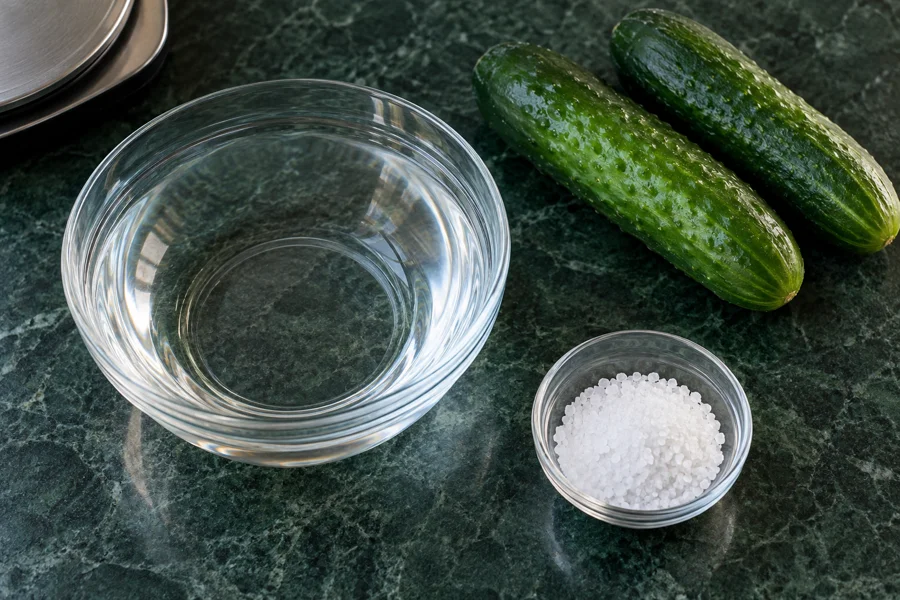
Water, plain salt, a kitchen scale and cucumbers prepared on a green countertop.
Measure by mass

Grams travel better than tablespoons.

Fine salt and coarse salt pack differently into a spoon. Weighing makes a recipe’s salt amount repeatable without relying on a salt brand’s volume.

For water, the calculator approximates 1 mL as 1 g. US cups, quarts and gallons are US customary units; they are not Imperial units. Ounces in weight selectors mean mass, not fluid ounces.

For a larger batch, choose Scale recipe. Enter the original water, salt and food amounts when applicable. The tool multiplies every included ingredient by the same factor and keeps the calculated ratio unchanged.

When finding a percentage, the result describes the quantities entered. It does not measure an unknown, used brine or account for dissolved sugar, juices or other ingredients.

Common brine questions

How much salt do I need for a 3% brine?

If your recipe means 3% of water weight, use 30 g salt per 1,000 g water. If it means 3% of salt plus water, use approximately 30.93 g salt with 1,000 g water. Choose the recipe’s definition in the calculator.

Do I include the fish or vegetable weight?

Only when the recipe calculates its percentage from food plus water. Select that method and enter the food mass. Do not include the jar or container.

Can I use this for dry salting?

Yes, for plain-salt arithmetic. Select Food + water weight, enter the food weight and set water to 0. Use your recipe’s specified percentage. This tool does not calculate nitrite curing salts.

Does 5% salt guarantee safe preservation?

No. A ratio alone does not establish a safe process. Food type, acidity, temperature, treatment and storage conditions matter. Follow a tested recipe without changing its required proportions.

Can I use cups for salt?

The calculator outputs salt by weight because salt volume varies with crystal size and brand. Use a scale and plain salt appropriate to the recipe.

Are my recipe amounts saved?

No. Calculations run in your browser, and the tool does not save or transmit your ingredient amounts. The hosting service may process standard request information to serve the page. No external analytics or advertising script is installed in this version.

Methodology & sources

Ingredient ratios use the formulas shown above. Water volume uses an approximate density of 1 g/mL.

NCHFP / USDA: fermented foods and tested proportionsOregon State University: preparation of salt brines

Reviewed October 5, 2026

Independent kitchen tool.
Plain salt calculations only.